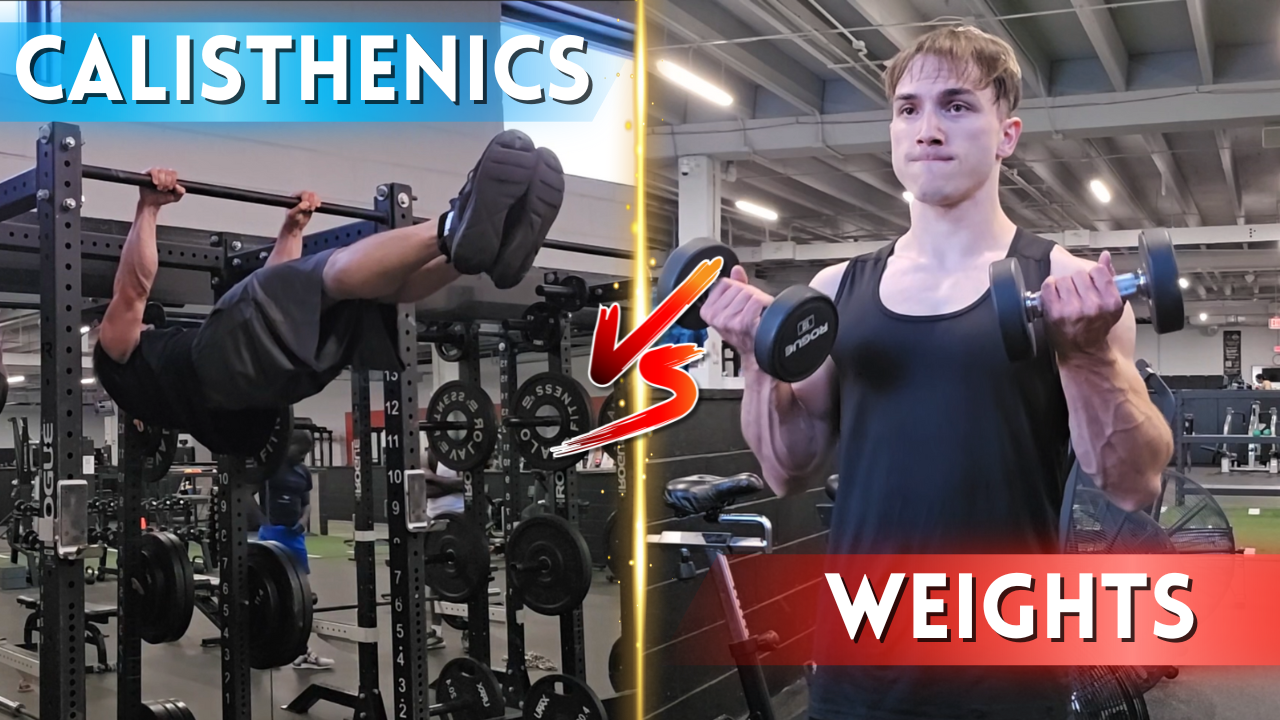
Calisthenics Vs Weightlifting: Which is better?
Are you trying to decide between doing calisthenics and weight lifting and want to know which one is better?
My name is Andrew and I help entrepreneurial men in their 20's and 30's build athletic physiques and functional strength with calisthenics.
In this post we are going to be focusing on calisthenics vs weightlifting: which is better?
Calisthenics Vs Weightlifting: Which Is Better?
Intro
To give you a little background on me, I started working out when I was 14. I started with a 15lb dumbbell and my own bodyweight because I lived in a camper at the time and it was all I had
Later I got into the gym and barely knew what to do and tried a variety of things that never worked.
Over the years I was in and out of the gym, but it wasn't until I got into calisthenics that I developed a real passion for fitness.
At that point I got serious and consistent about my fitness journey, so much so now that I have become a coach
Over the years I have incorporated a lot of weights and external resistance into my training.
Both have their pro's and cons, and in this post I am going to break them all down
Before jumping into the differences, let's actually define what both are. Calisthenics is any form of bodyweight-only training.
This includes exercises like push ups, pull ups, bodyweight squats, and so forth
Weight lifting will include any form of external resistance training, including cables and bands.
But what about weighted calisthenics?
Weighted calisthenics to me is still considered calisthenics, even though many people would consider it to be weight lifting because of the external weight.
I include it in with calisthenics more so than weight lifting because you are still doing bodyweight exercises, just with more weight on you.
Weighted calisthenics play a huge part in achieving advanced levels of calisthenics strength, and you rarely see anyone who isn't a jogger or calisthenics athlete using a weight vest, so to me weighted calisthenics still qualifies as calisthenics
With all of that out of the way, lets jump into the comparison and pro's and cons of both
Calisthenics Vs Weightlifting: Calisthenics
1.) Pro's Of Calisthenics
Affordable: Obviously, it doesn't cost anything to use your own body weight. With calisthenics, you don't necessarily need any kind of equipment to get started, meaning it's totally free. However, I would recommend you at least find a park with pull-up bars and dip bars, or buy some for your home so you can do pull-ups and dips at home. These won't cost you nearly as much as weights, cable machines, or a high-end gym membership in the long run.
Functional Strength: Many guys who lift weights may look strong, and in many ways, they might be, but is that strength functional? What I mean is, just because they can deadlift 300 lbs doesn't mean they can lift their own body weight with a pull-up or perform a high box jump. The fact is that the strength you gain from calisthenics translates far better to real-life activities, sports, and daily tasks than the strength you gain from weights.
Increases Joint Strength & Mobility: Calisthenics tends to be lower impact on your joints and holds lower risk of overloading them due to the exercises' lower impact nature. Additionally, calisthenics exercises encourage movements that utilize the natural range of motion for your muscles and joints, causing less wear and tear on your joints while increasing your mobility. In the long run, calisthenics will be better for your joint health.
Translates Well to Weights: Just because you can bench press 200 lbs doesn't mean you can hold a 90-degree hold, but if you can hold a 90-degree hold and do pseudo push-ups, you can probably lift a decent amount of weight on the bench press. The kind of strength you develop from both forms of training is very different, and while you may not break any squatting or deadlifting records if you only do calisthenics, you can probably still lift a lot of weight. On the other hand, a bodybuilder is going to struggle with 90-degree holds and muscle-ups if they haven't trained for them.
There Is Always Something to Work Towards: This is probably the main thing that drew me to calisthenics. I saw these incredible bodyweight movements and knew I wanted to achieve these feats of strength. Chasing a bigger number on the side of a dumbbell just didn't excite me, and while weightlifting made me like fitness, calisthenics made me love it. There is always another skill to master, another feat of strength to achieve, and ways to improve on skills you have already mastered. Every time you achieve a new skill, you have a deep sense of accomplishment because it probably took you months or even years to master it. Because of this, you will always have something to work towards and always have motivation.
Turning Heads: This may not be what got you into calisthenics, but it's definitely fun to perform these incredible exercises and turn heads and have people coming up to you asking questions. Sometimes the reactions are funny, and from time to time, I even catch people watching me in my recordings. It's always enjoyable to meet new people and talk to them about how I got into calisthenics and how long it took me to master certain skills. So, if getting attention is something you enjoy, calisthenics will definitely get you that.
Supportive Community: The calisthenics community is niche but very supportive. You can find calisthenics groups and communities on Facebook who are eager to help and support you on your journey. If you are fortunate enough to have a calisthenics community in your area or come across a fellow calisthenics athlete, you are bound to have a great and friendly conversation because everyone in the community is so supportive and kind. This support can really help when you're starting out to stay inspired and motivated.
Mind-Body Connection: It takes a lot of coordination to do handstand push-ups and muscle-ups. You have to ensure you are performing every movement correctly with your whole body, engaging your core, keeping your arms and legs straight, etc. If any one of these things is off, your form will suffer, and you will struggle to perform the exercise. You don't need as much coordination when doing curls or overhead presses, but without it, you will never master handstands and planches. Calisthenics is excellent for developing that mind-body connection, even more so than weightlifting.
2.) Cons Of Calisthenics
Limited Resistance Progression: With calisthenics, you are limited and restricted by your current body weight. This means it's very difficult to make an exercise easier or harder if your body weight isn't sufficient. Sure, you can do progressions and regressions. Take the handstand push-up, for example. You have pike push-ups all the way to wall handstand push-ups, and eventually, off-the-wall handstand push-ups. However, if you find that pike push-ups are too easy but wall handstand push-ups are too hard, without adding a weight vest, you may be out of luck.
You may also find that you are doing too many pull-ups, for example. Again, without adding extra weight, you may not be able to break past that plateau and see more gains. Or perhaps you are trying to do a 90-degree hold but can't support your weight. Without a resistance band to offload some of the weight, you may struggle to keep progressing. The point is, it's easy to get stuck with calisthenics if you refuse to use any other equipment.
Difficult to Isolate Muscles: This is one of the biggest downsides to calisthenics. Most of the exercises are compound movements and incorporate multiple muscles at once. This can be good in the sense that you are working multiple muscles simultaneously and in unison, but it can be bad in the sense that supporting muscles can get tired before the muscle you are trying to target. For example, your forearms or biceps may get tired before your lats during a pull-up, or your shoulders may get tired before your chest during a push-up. Because of this, not being able to isolate muscle groups can hinder your progress.
Progression Plateaus: This ties in with the first point, but it's a little different. In calisthenics, it can be very easy to get stuck, even if you use weights and bands. For example, bands and weights aren't going to help you with a handstand. I was stuck trying to master the handstand for a while, and my breakthrough eventually came from training the belly-to-wall handstand more often. The same goes for the muscle-up.
Bands and weighted pull-ups definitely helped me build the strength to get there, but even when I had the pure strength, I still had a hard time achieving a muscle-up in strict form, and from there, getting more than a few consistently. Training high pull-ups exclusively for a few months really helped me get past that plateau. With the planche, I plateaued for a while and finally started to break through after beginning a new planche routine. Plateaus will happen, and they will be very frustrating, whereas with weights, you can gradually add a little more weight each time.
Not Easily Accessible if You Are Overweight: If you are overweight, especially by a significant amount like 50+ lbs, then calisthenics exercises can be very difficult. I'm not saying you can't do them, but they will be much harder and very uncomfortable. If this is you, you may find it easier to start with weights.
Less Variety: With calisthenics, you are pretty much limited to what you can do with your body alone as resistance. In many cases, this means you will be doing different variations of similar exercises like different push-up, pull-up, and squat variations. This also means you will have to get creative to target all the muscles in your body, which can sometimes be very difficult with just your body weight alone. For many people, this can actually make the training boring because they want to mix it up more often, but they can't or don't know how, ultimately causing calisthenics to lose its appeal.
Less Likely to Have a Training Partner: This was never important to me, as I have always trained alone, but for those of you who like to have a partner, it may be hard to find someone in your area who also does calisthenics. You may get lucky and find someone through an online group, or if you live somewhere like Miami or LA, it might be easy, but here in Nashville, it is not easy at all.
Limited Leg Development: Our legs carry our body weight all day, so doing bodyweight-only exercises can sometimes yield less-than-desirable results. That's not to say you can't develop your legs with body weight, because you certainly can see some results, but eventually, body weight will get too easy. It just won't be practical to do 200 bodyweight squats or 200 calf raises to try to achieve hypertrophy and muscle growth. This is one area where weights are superior.
Calisthenics Vs Weightlifting: Weightlifting
3.) Weightlifting Pro's
Easy to Isolate Muscles: Where calisthenics struggles, weights come in to save the day. It's very easy to isolate specific muscles you want to target, like biceps, triceps, forearms, and so forth with weights. With calisthenics alone, this can be very difficult, but with weights, you can hone in on your weaker muscles and target them, or isolate a muscle you really want to grow. This can make building muscle across every muscle group in your body much easier than with calisthenics. This is possibly the biggest benefit of weights over calisthenics.
Progressive Overload: It's very easy to continue increasing the difficulty with weights—simply increase the weight. Where calisthenics on its own struggles in this area, weights make it super simple, which makes it easier to see improvements in your strength levels and muscular development.
Variety: There are so many exercises out there to choose from that you could mix up your routine forever. Calisthenics is often limited by what you can do with your body, but with weights, you can do over 10 different squat variations and countless different types of rows. You have many more options to keep your routines fresh and fun.
Training Partners: Finding a training partner to lift weights with is easy—just go to any gym. Almost everyone lifts weights, so if having a partner is important to you, you won't have too many challenges finding one.
Effective Leg Training: As mentioned earlier, leg training is better with weights. You can continue to progressively overload your leg exercises simply by adding more weight in exercises like the squat or the glute bridge. One may argue that the squat is, in fact, just a weighted calisthenics exercise, but for the sake of this discussion, we will consider it a weightlifting exercise. For anyone wanting to achieve serious leg development, even if you are a calisthenics athlete, weights are the better way to go.
3.) Weightlifting Cons
Not Free: Whether you decide to pay for a gym membership or purchase your own equipment, it is not free, and it possibly won't be cheap. Many gyms these days, especially ones that aren't franchised, will cost around $50-$60 per month, and nicer gyms in more expensive parts of town can cost $100 or more per month. This can be a problem if money is already tight. However, a Planet Fitness membership is pretty affordable, and usually, you can find a reasonable option out there, so this typically isn't a huge problem.
Higher Risk of Injury: It's much easier to injure yourself if you are irresponsible. Lifting more weight than you can handle or doing it incorrectly can lead to injury quickly or over time. Take a deadlift or squat, for example. Incorrect form or too much weight in a squat can wear on your knees over time, and the same can happen with a deadlift, potentially causing you to injure your back in one set. Not to mention, many exercises out there are dangerous for your body, like upright rows or the guillotine bench press. When using weights, be sure to educate yourself and don't push yourself too far too soon.
More Wear and Tear on Your Joints: Using weights can be hard on the joints, especially with heavy lifts and exercises that cause joint compression, like squats and deadlifts. Over time, the extra load can cause wear and tear on your joints. Additionally, because many weightlifting exercises isolate specific muscles, if you don't ensure balance on both sides, you can end up with muscle imbalances that cause unnecessary stress on the joints. Between improper form, high impact and heavy lifts, and repetition over time, weightlifting can take a real toll on your joints.
Muscle Imbalances: With weightlifting, it's not necessarily required for all of your muscles to work together to perform an exercise. For example, when doing a dumbbell curl, the only muscles really at work are your biceps and forearms. When doing a front delt raise, your front delts are primarily the only muscles being engaged. Because of the ability to isolate muscle groups, it can be easier to develop muscle imbalances or not recognize that you have them at all. However, this isn't as true for exercises like squats or deadlifts. These exercises recruit multiple muscle groups at once, making muscle imbalances more noticeable. On the flip side, the ability to isolate muscle groups can also correct muscle imbalances if you are intentional with your training and recognize where you have weaknesses.
3.) In Summary
Both forms of training have their strengths and weaknesses, and there is a time and place for both.
Calisthenics has the benefits of being free and accessible to everyone, but it will be more challenging if you are overweight. Calisthenics is also great for mobility, joint strength, and translates well to weights. If motivation is something you struggle with and accomplishing goals is what drives you, then you will always have something to work towards with calisthenics, which can be exciting and keep many athletes motivated to keep going to the gym.
However, for many people, the limited ability to progressively overload and isolate specific muscle groups can make it difficult to keep progressing and may cause you to plateau, which can be very discouraging and frustrating. Not only that, but you may actually find yourself getting bored due to the limited exercise variety available if you stick strictly to bodyweight. And don't forget about your legs—building your legs using calisthenics alone can be very difficult, leaving an entire muscle group undertrained.
With weights, on the other hand, isolating specific muscle groups is a breeze. Want to focus on biceps? Do some curls. Want to hit just your chest? Do some cable flies. Hitting your legs and pushing them to failure becomes much easier as well. You also have a lot more variety in terms of exercises available to you, which can keep your routine from getting repetitive and boring.
But with all these positives come some downsides. These include having a bigger financial investment upfront to either buy equipment or pay for a gym membership, which can be cheap or expensive depending on what gyms you have access to. You also have a higher risk of injury from lifting too much, lifting improperly, or lifting in an unnatural way. Over time, weights, especially heavy weights, will cause greater wear and tear on your joints, leading to more pain and problems down the line if you don't know what you are doing. You also have to pay close attention when weightlifting to catch any muscle imbalances that may arise from constantly isolating muscles and not training them together.
In my opinion, the best way to train is with hybrid calisthenics because you get the perks of both training styles and avoid many of the negatives that come with each. They complement each other very well, and when combined, you will become a well-rounded and well-developed athlete.
If you are looking to start hybrid training but don't know where to begin, shoot me a DM over on my Instagram, and we can talk about your goals and see if we might be a good fit to work together.
If you enjoyed this post and want to watch the video version, head on over to my Youtube channel
